Menu
Resources

Resources

Home / Resources / Blog / PCB vs PCBA: What Is the Difference Between a Printed Circuit Board and a Circuit Board?

PCB vs PCBA: What Is the Difference Between a Printed Circuit Board and a Circuit Board?

Release time:10/17/2026
Share to:

 1.  PCB Is the Bare Board, PCBA Is the Functional Assembly

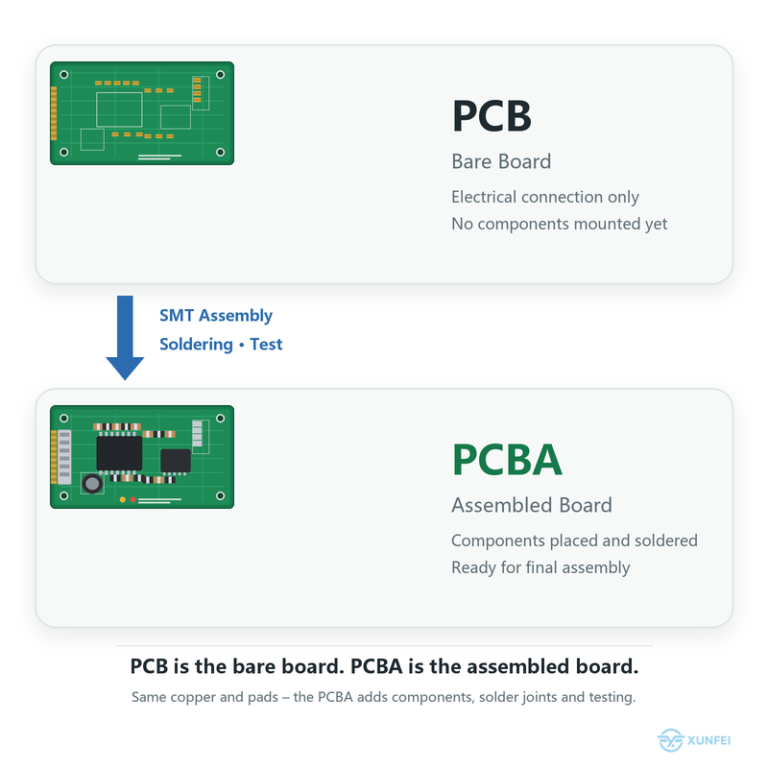
    The simplest answer is this: a PCB, or Printed Circuit Board, is the board itself, while a PCBA, or Printed Circuit Board Assembly, is a PCB with electronic components installed and soldered onto it. A bare PCB provides the physical structure and the conductive paths, but it usually cannot perform the full function of an electronic product on its own. A PCBA adds resistors, capacitors, integrated circuits, connectors, and other components, so the circuit can work as designed. In casual purchasing language, "circuit board" is often used loosely for an assembled board, hence the PCB/PCBA distinction below.

    Put simply, in electronics manufacturing, a PCB or Printed Circuit Board is a bare board built with conductive patterns but no assembled components. A PCBA, or Printed Circuit Board Assembly, is a functional board on which components have already been mounted and soldered. In practice, technical specifications and quotations should state clearly whether the deliverable covers component sourcing, assembly, soldering, inspection, and functional testing.

   This distinction matters when you define a manufacturing or purchasing requirement. If you only need the fabricated board, request a custom printed circuit board or a bare PCB. If you need a ready-to-test electronic assembly, choose Printed Circuit Board Assembly, or PCBA. By separating PCB fabrication from PCBA assembly, you get an accurate printed circuit board cost, a complete delivery scope, and a realistic production schedule.

2. What Is a PCB or Printed Circuit Board?

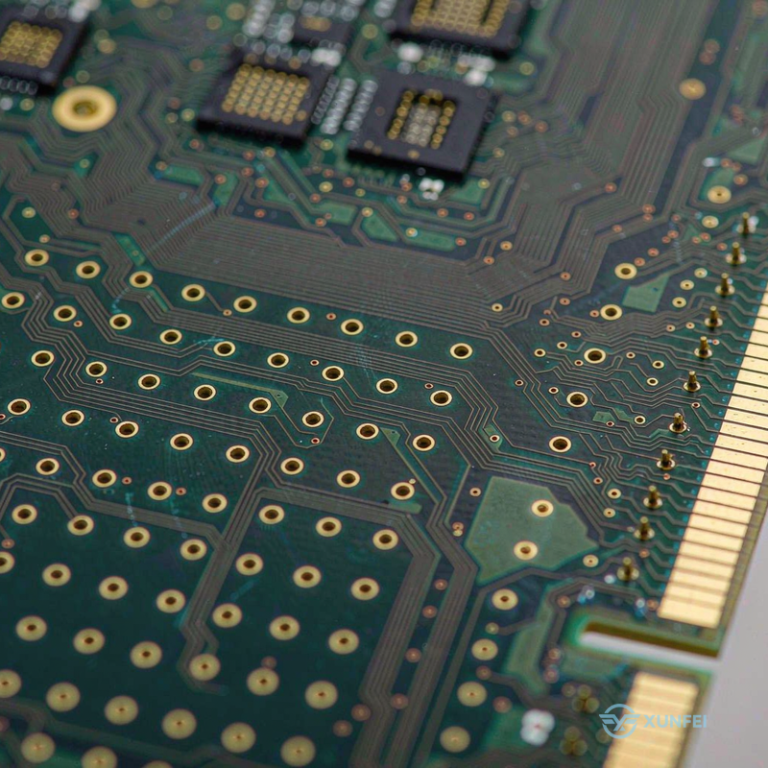
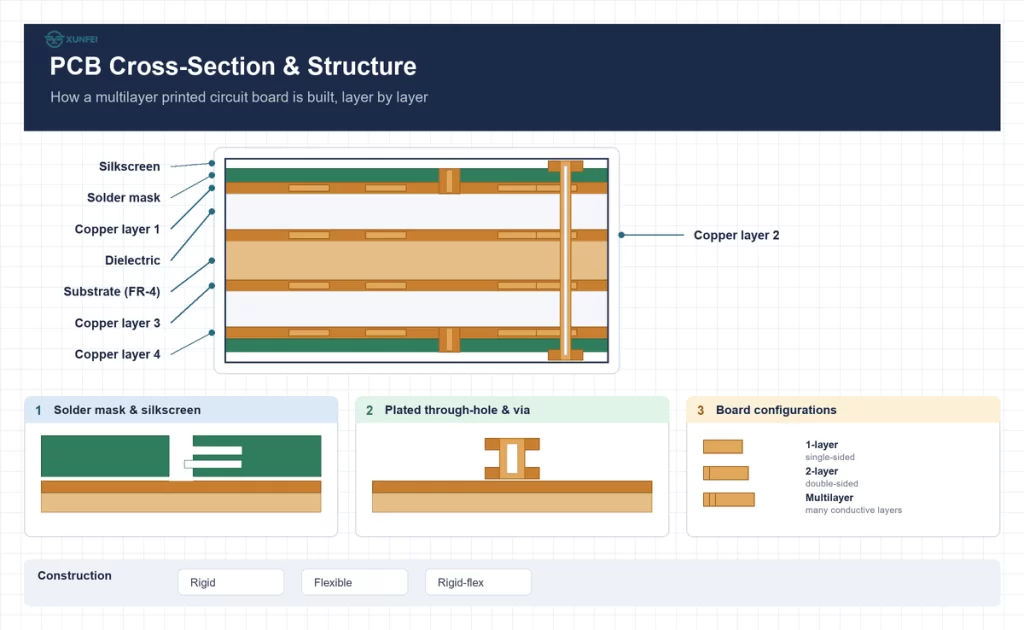
    A PCB is a laminated board that supports components mechanically and connects them electrically through copper traces, pads, vias, and other conductive features. Manufacturers commonly build PCBs from fiberglass-reinforced laminate or epoxy-based materials. A PCB may have one, two, or many conductive layers when the routing density is high. It may also be rigid, flexible, or rigid-flex.

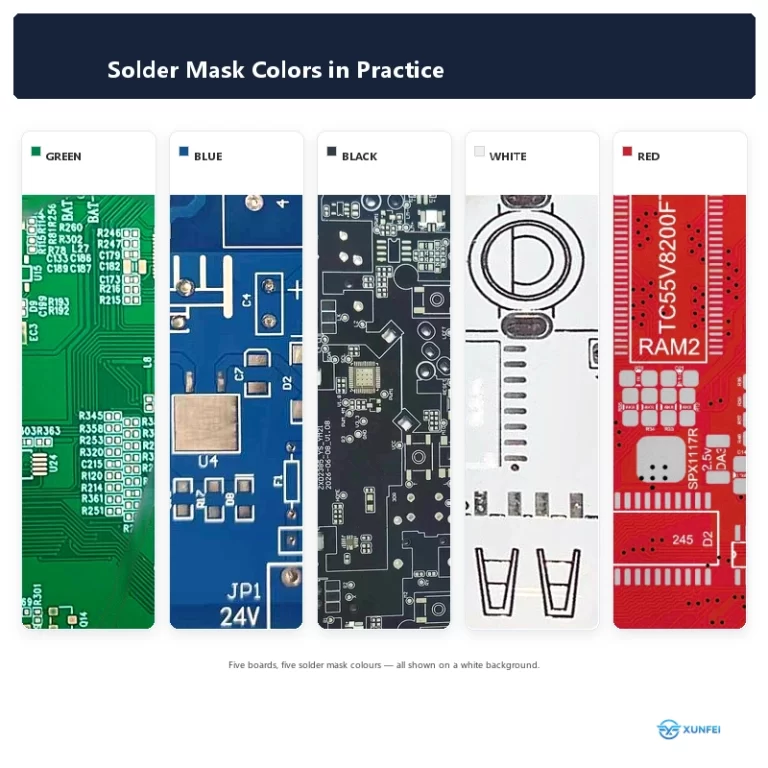
    The main parts of a PCB are the substrate, copper layers, solder mask, silkscreen, pads, vias, and plated holes. These features do not replace components; instead, they create the platform that later holds them. PCB manufacturing therefore focuses on producing a board that matches the design files, electrical rules, mechanical dimensions, and reliability requirements.

    A PCB can be simple or highly complex. A small single-sided board may serve a basic control circuit, while a multilayer HDI board may support dense computing, communications, medical, or automotive applications. In each case, the right design depends on current, signal speed, thermal conditions, mechanical space, safety requirements, and production volume.

Cross-section diagram of a bare PCB showing layered copper conductive patterns, substrate, and surface finish.

 3. What Is a PCBA or Printed Circuit Board Assembly?

    A PCBA is the result of assembling electronic components onto a PCB. The assembly process typically includes solder-paste printing, component placement, reflow soldering, selective soldering, through-hole soldering, inspection, programming, and functional testing. During this stage, SMT handles small, dense components, while through-hole technology gives selected parts a stronger mechanical connection.

    A PCBA is not automatically a complete finished product. It is a functional board-level assembly, and it may still need enclosure integration, cabling, programming, calibration, or system-level testing. That is why a project brief should state whether you need PCBA only or a complete box-build manufacturing service.

    A reliable printed circuit board assembly manufacturer should manage your bill of materials, approved component alternatives, soldering requirements, inspection criteria, and test records. For regulated or high-reliability products, traceability and documented quality controls matter even more.

4. The Main Differences Between PCB and PCBA

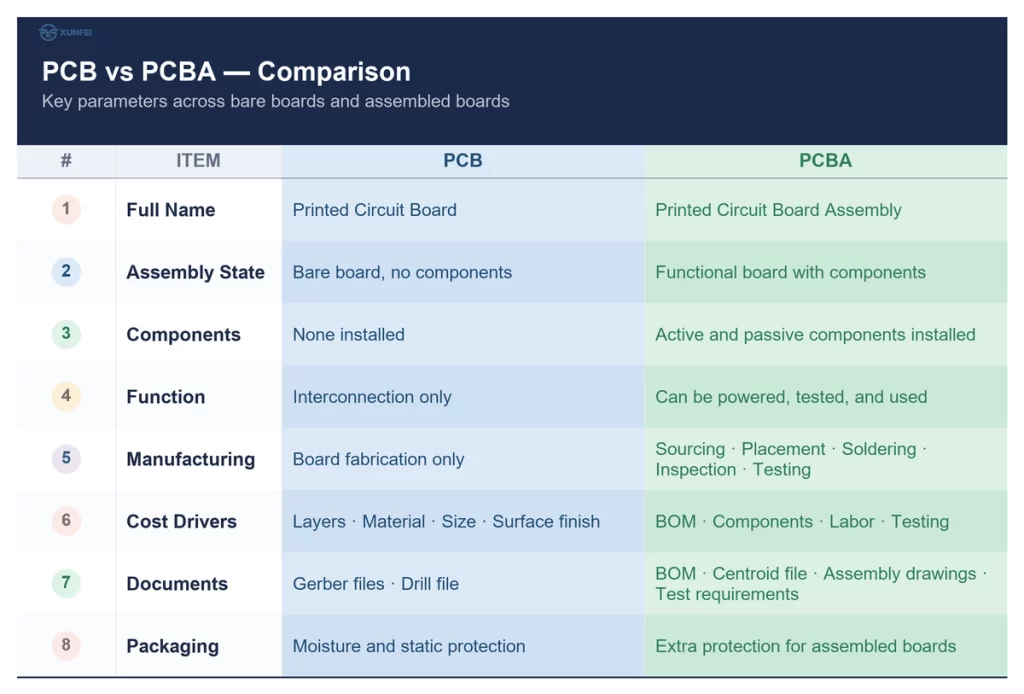
The core difference is the assembly state. Manufacturers build a PCB as a component-ready board, and they deliver a PCBA only after component assembly and soldering. The table below summarizes the practical differences:

PCB vs. PCBA Comparison Table

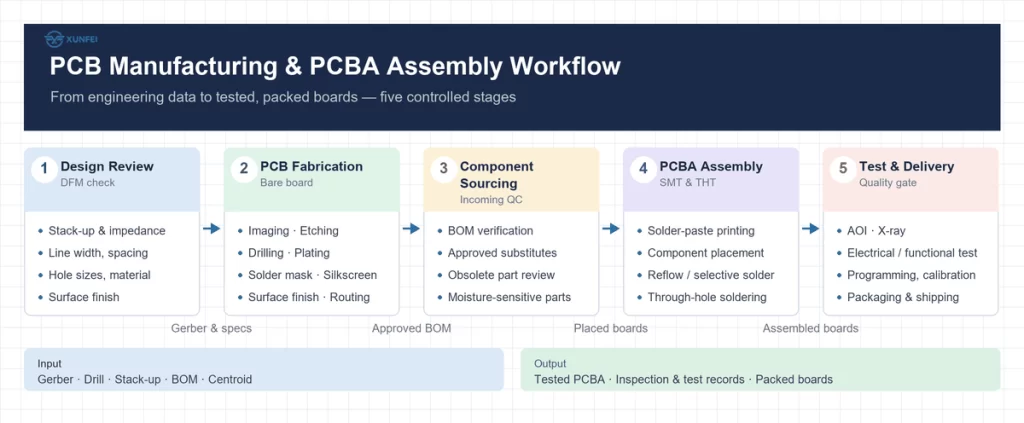
5: PCB Manufacturing and PCBA Assembly Workflow

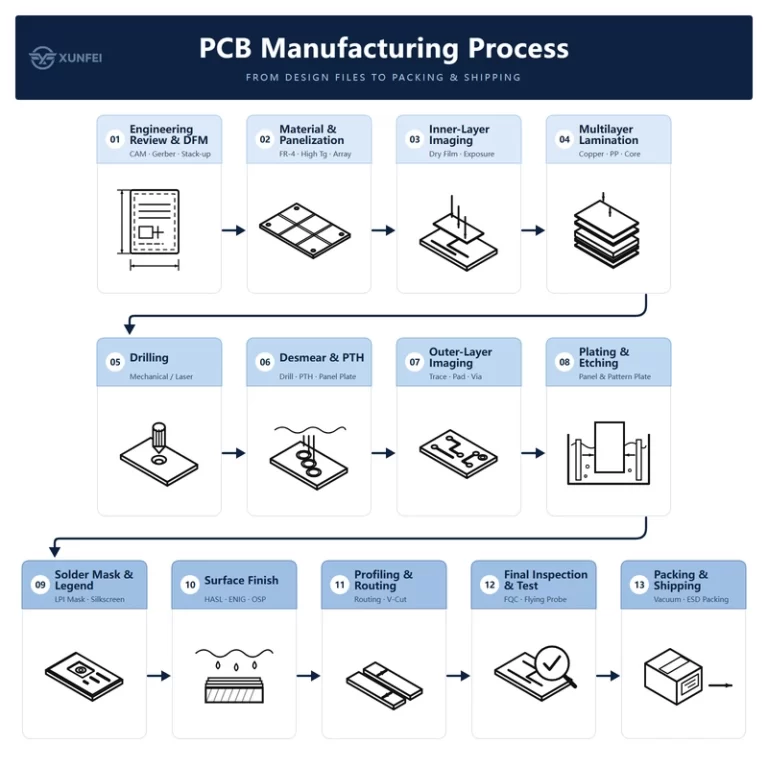
    A typical project starts with a design review. The manufacturer checks the stack-up, line width, spacing, hole sizes, impedance, material, surface finish, and manufacturability. Once you approve the review, the PCB factory produces the bare board through imaging, etching, drilling, plating, solder-mask application, surface finishing, routing, and electrical testing.

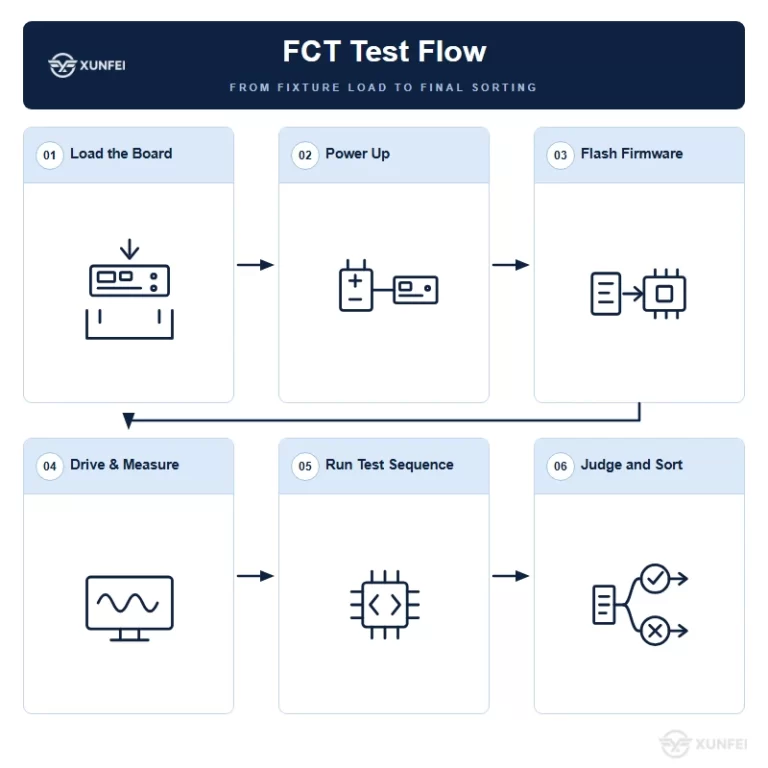
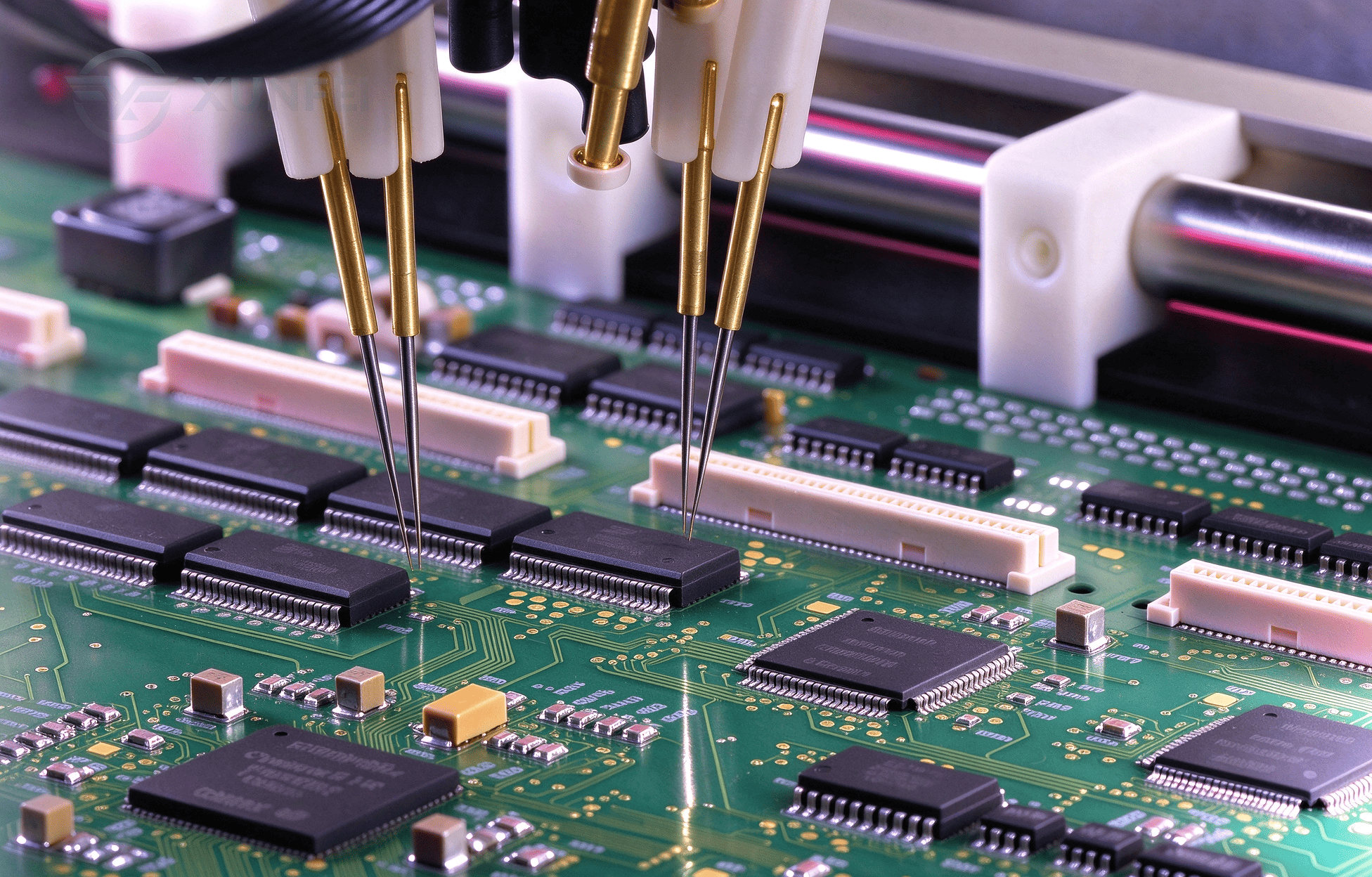
    For PCBA, the next stage begins with component sourcing and incoming inspection. The line prints solder paste, places components, and passes the board through reflow or another soldering process. Assemblers then inspect the board with automated optical inspection(AOI), X-ray inspection when needed, and electrical or functional tests. These steps help catch solder defects, wrong or missing components, polarity errors, and connection problems.

    So the complete workflow is not simply “make a circuit board.” It is a controlled chain that runs from engineering data to production, inspection, testing, packaging, and delivery. Clear files and acceptance criteria reduce avoidable delays. 

Flowchart of PCB Manufacturing and PCBA Assembly

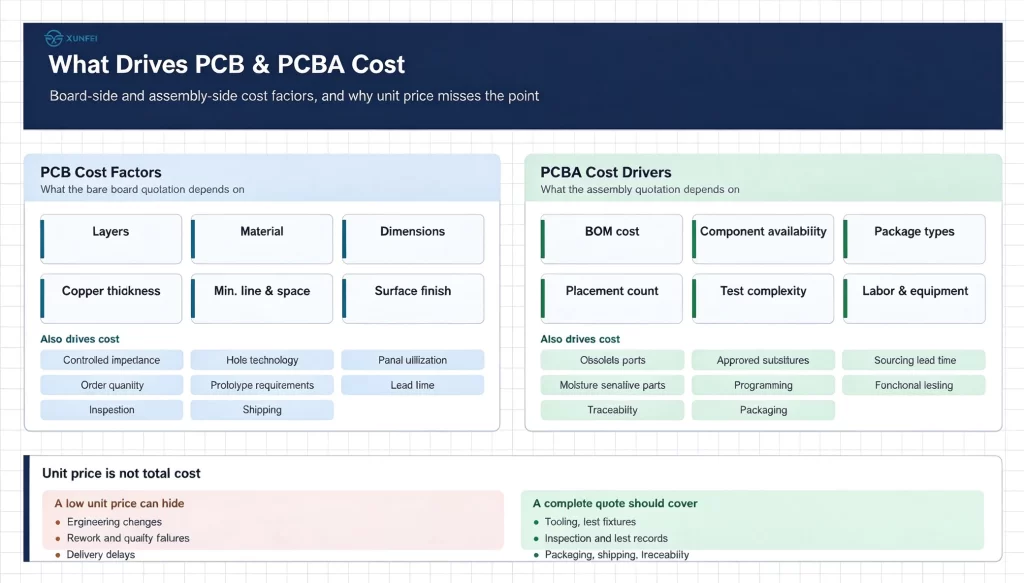
6. What Affects Printed Circuit Board Cost?

    Printed circuit board cost does not depend on board size alone. Key factors include layer count, dimensions, material, copper thickness, minimum line and space, hole technology, controlled impedance, surface finish, panel utilization, order quantity, prototype requirements, lead time, inspection, and shipping. For PCBA, the bill of materials often becomes the main cost driver, because component prices, availability, package types, placement counts, and test complexity vary widely.

    To get a useful quotation, send the latest Gerber package, board specifications, quantity, target delivery date, BOM, component files, assembly drawings, and test requirements. A low unit price is not always the lowest total cost, because it can lead to delays, quality problems, or repeated engineering changes.

Diagram of PCB and PCBA Cost Composition and Influencing Factors

 7.  How to Choose a PCB Factory or PCB Assembly Manufacturer?

    When you compare printed circuit board manufacturers, look beyond price. Review their experience with your board type, their material and layer capability, engineering support, inspection equipment, production capacity, quality records, change control, traceability, and communication process. Ask for sample evidence that fits your application, instead of relying on a general company profile.

    If you need PCBA, confirm that the supplier is a true printed circuit board assembly manufacturer with sourcing, SMT, through-hole, rework, programming, and testing capabilities. Also confirm how the supplier handles obsolete parts, approved substitutes, moisture-sensitive devices, and non-conforming products.


 8. How to Buy the Right PCB or PCBA Service?

    To buy printed circuit board products efficiently, define the deliverable first. Choose a bare PCB when you will manage component assembly yourself. Choose a custom printed circuit board service when your board needs special materials, dimensions, impedance control, or reliability features. Choose a printed circuit board service that includes PCBA when you need assembled and tested boards.

    A complete RFQ package normally includes Gerber files, drill data, stack-up information, material requirements, surface finish, quantity, BOM, centroid data, assembly drawings, programming files, test procedures, packaging requirements, and target delivery date. The more precisely you define the deliverable, the easier it is for suppliers to quote and manufacture consistently.

9. FAQ

-Are a circuit board and a wiring board the same thing?

Not always. People often use the two terms interchangeably in casual speech, but a wiring board usually means a bare PCB, while a circuit board often means a component-populated PCBA. Always confirm the scope with your supplier.

-Can a bare PCB work by itself?

A bare PCB provides interconnection, but it normally cannot perform the full product function without the required electronic components.

-Is PCBA the same as a finished electronic product?

No. A PCBA is a functional board-level assembly, and it may still need enclosure integration, cabling, programming, calibration, or system-level testing.

-Is PCB manufacturing the same as PCB assembly?

No. PCB manufacturing produces the bare board, while PCB assembly installs and solders components onto that board and often includes inspection and testing.

-How can I reduce the cost of a PCB project?

First, simplify the design where you can. Then choose materials based on actual requirements, improve panel utilization, consolidate quantities, confirm component availability early, and define test requirements before you request a quotation.

-Should I choose a PCB board manufacturing company or an integrated supplier?

Answer: Choose a PCB board manufacturing company when you only need bare boards. Choose an integrated supplier when you want sourcing, assembly, testing, and delivery coordination from one partner.


 

XUNFEI turns nearly 30 years of circuit-industry expertise into one-stop PCB & PCBA manufacturing—design, fabrication, SMT assembly, and functional testing under one roof. ISO9001- and RoHS-certified, IPC-compliant production with AOI and X-ray inspection delivers prototypes in 4-7 working days and mass production in 8–15. With NDA-protected data, upfront DFM review, and tiered pricing, XUNFEI brings your hardware to market faster, safer, and at lower cost. Get your quote today.

RECOMMENDED NEWS